What do you call a downtown that got rebuilt after the thing that made the town famous had already disappeared once?
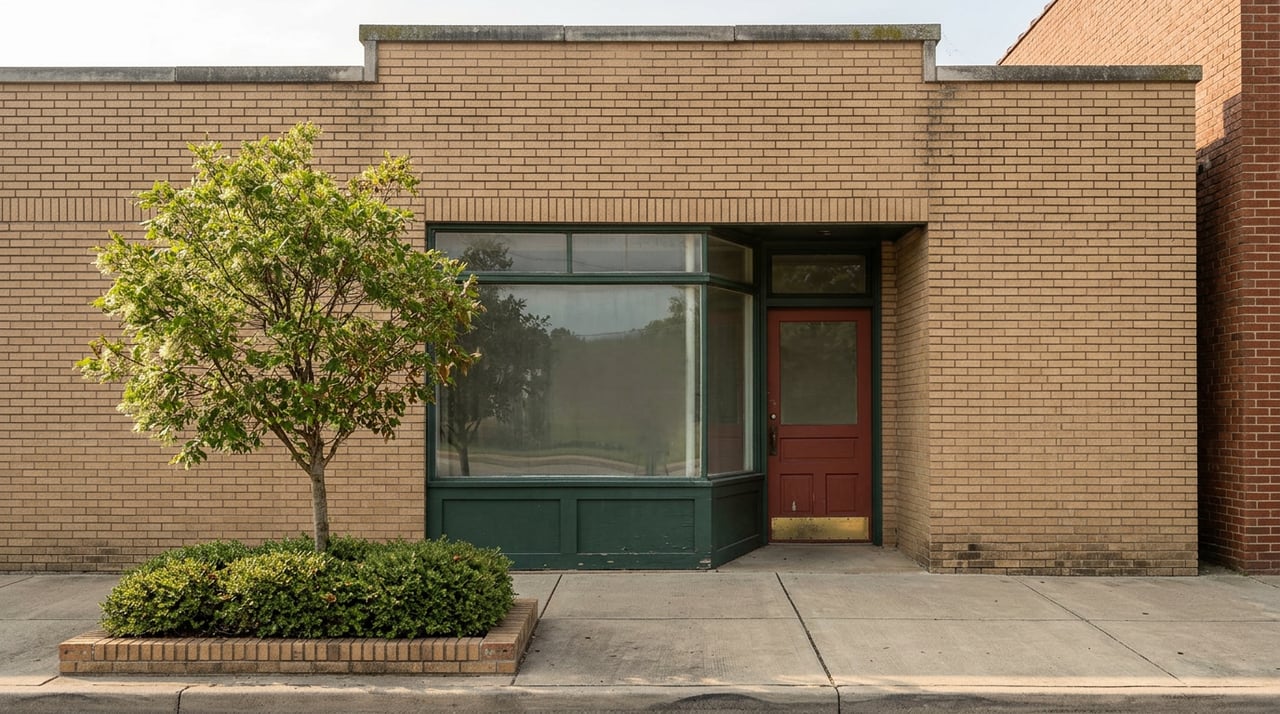
That's the question sitting underneath the news that came out of Sour Lake this July. The Sour Lake Downtown Historic District, three blocks centered on Sixth and Merchant streets, was officially added to the National Register of Historic Places. Everybody covering it led with the same angle: birthplace of Texaco, oil boom, historic preservation. All true. But if you've driven Sixth Street more than a few times, you know the more interesting part of this story is what the buildings replaced, and what they're standing in for that isn't there anymore.
Fourteen Buildings, Two Eras
The district itself is small. Fourteen buildings, built between 1903 and 1966, most of them sharing party walls along Sixth and Merchant. Six went up between 1916 and 1920. One, the First M.E. Church South at 615 Sixth Street, dates to 1921, a three-story Mission Revival building with stained-glass windows that mark the town's shift from boomtown to something more settled. A handful of others came later, in the 1930s, 1950s, and 1960s, filling in the block over decades rather than all at once.
Texas has more than 3,300 properties on the National Register. Sour Lake's addition is a modest sliver of that list, but it's a specific one, and specificity is the point. This isn't a plaque commemorating an idea. It's fourteen actual buildings, each with an address and a construction date, still standing on the same two streets they were built on.
The Building That Survived the Fire
The centerpiece of the district is the Carpenter Building at 730 Sixth Street. It went up in 1903 as the home of the First National Bank, and it holds a distinction none of the other buildings can claim: it's Sour Lake's first brick building, and the only major downtown structure to survive the fire that tore through in 1904.
That fire matters more than it sounds like at first. Most of Sour Lake at the time was wood-frame, thrown up fast to house an oil boom population, and fire took most of it in one night. What came after wasn't a rebuild in the same materials. It was a decision to build in brick this time, for permanence, with the surviving Carpenter Building as the anchor everyone else built around.
A few of the other contributing buildings in the district, if you want the specifics:
- Carpenter Building, 730 Sixth Street, built 1903, the only two-story building in the district and the sole downtown survivor of the 1904 fire
- Merchant Street Commercial Block, 125 and 135 Merchant Street, built around 1916 by Ambrose Merchant, part of the post-fire rebuilding effort
- Citizens National Bank Building, 685-689 Sixth Street, completed 1920, still showing traces of early business signage across multiple storefronts
- First M.E. Church South, 615 Sixth Street, built 1921, three stories, Mission Revival, stained glass
Ambrose Merchant is the name behind Merchant Street itself. He was a Sour Lake oilman who got elected mayor and then put his money into rebuilding the commercial block that still carries his name. That's not incidental civic trivia. It's the difference between a town that burns down and disperses, and one where the same people who made money in the boom turned around and built the permanent version of downtown.
What the Boom Erased Before It Ever Got to the Fire
Here's the part that doesn't make it into most of the coverage. Sour Lake wasn't originally an oil town at all. Long before the derricks, it was a resort. Sulfur-rich mineral springs fed a small lake, and by 1850 the town had a hotel and a reputation as a place to come take the waters for whatever ailed you. Sam Houston came more than once, and according to the Texas Almanac, spent a month there in 1863 taking mineral baths for old wounds.
That resort economy ran for decades, and then oil wrecked it. Wells started coming in around 1901, and the same drilling that made Sour Lake the birthplace of Texaco also pulled so much water and pressure out of the ground beneath the springs that they simply stopped flowing. The hotel that once drew health-seekers from across the state has no physical trace left downtown today.
Except it does, sort of. On the east elevation of the building at 125 Merchant Street, part of the Merchant Street Commercial Block, there's a stucco wall with a mural of the 1883 Sour Lake Springs Hotel painted on it. The mural is on one of the very buildings the National Register just recognized, a painted memory of the town's first identity, hanging on a wall from the second one.
There's a monument in front of the Alma Carpenter Public Library, where the Bertha Terry Cornwell Museum keeps its collection of Texaco artifacts and founding-family history. Its inscription doesn't leave room for interpretation: "This monument marks the site of the Texas Company's first producing oil well." The well it marks flowed at 5,000 barrels a day starting in January 1903, and the town's population reportedly swelled from around 150 residents to an estimated 10,000 within that same year. Today it sits closer to 1,850. The math on that swing is the whole story of Sour Lake in one number.
What the National Register Listing Actually Does
Getting listed doesn't freeze anything in place or force any building owner's hand. What it does, according to the coverage around the designation, is open the door to preservation resources, technical assistance, grant opportunities, and potential federal tax incentives for owners who want to restore a qualifying building. None of that is automatic and none of it is a mandate. It's an option that exists now for the fourteen specific addresses in the district that didn't have it before.
For a town this size, with a downtown built one rebuilding effort at a time, that kind of access matters more than the honor of the listing itself. A brick storefront going up in 1920 to replace something a fire took in 1904 is exactly the kind of building this designation is built to help keep standing another hundred years.
Where to Actually See It
If you want to walk this instead of just reading about it, start at Sixth and Merchant. The Carpenter Building anchors the corner. The mural of the old hotel is a few doors down on Merchant Street. The First M.E. Church South's stained glass is worth circling around midday when the light hits it. From there it's a short walk to the Bertha Terry Cornwell Museum behind the Alma Carpenter Public Library at 300 South Ann Street, where the collection includes Texaco's founding history alongside Hardin County's original jail cells, in use from 1870 to 1888 and again as sub-jail cells decades later.
None of this changes what Sour Lake is day to day. It's still the same three blocks it was in June. But there's something worth sitting with in a downtown that got its identity taken from it once by a fire and once, more slowly, by the very industry that put it on the map, and chose both times to build the permanent version rather than walk away. The National Register just made that choice official.
If you're curious what else is happening in the small towns around Beaumont, or you've got questions about a piece of property in Hardin County, Beth Westbrook is always glad to talk it through. Let's Connect.