On September 1, while a Texas Windstorm Insurance Association committee met virtually to weigh whether vacation homes on the Bolivar Peninsula should lose windstorm coverage altogether, Tropical Storm Edouard was making landfall near the Texas-Louisiana line. Entergy was still restoring power to hundreds of Jefferson County customers when the committee voted to pull the proposal from consideration. The timing wasn't planned by anyone, but it made the argument for both sides in a single week. Second homes on this coast take on real storm risk. They also can't get windstorm coverage anywhere else if TWIA locks the door.
If you own a place on Crystal Beach, rent one out three weekends a month, or you're a few showings away from buying one, you probably heard some version of this story already. What most of the coverage skipped is the part that actually decides whether your closing happens on schedule: a single inspection document called a WPI-8, and it was never part of the vote.
What Actually Happened at the Table
The proposal on the table would have rewritten Texas Insurance Code Chapter 2210 to limit TWIA residential coverage to owner-occupied homesteads only. Beach cabins, weekend camps, and rental investment properties would have had to find wind coverage from a private or surplus-lines carrier, if one existed at a price anyone could pay. TWIA's own modeling, run by Aon, projected that dropping secondary homes would cut the association's probable maximum loss for the 2026 storm season from $4.305 billion to $3.395 billion, a 21 percent reduction, and shave net reinsurance costs from roughly $197 million to somewhere between $135 and $140 million.
Those numbers explain why the idea got a hearing. They don't explain why it went away just as fast. The committee voted to remove the secondary-home proposal from its 2026 Biennial Report entirely. Five other items moved forward for the full board to consider, covering things like multidistrict litigation reform and the FORTIFIED construction standard, but owner-occupancy restrictions weren't among them. Even if the full board had kept it in, the Texas Legislature would still have needed to pass a law before anything changed. Nothing here happened overnight, and nothing here is finished. A proposal that got pulled from one report can resurface in the next one.
Why Crystal Beach Was the Name Everyone Used
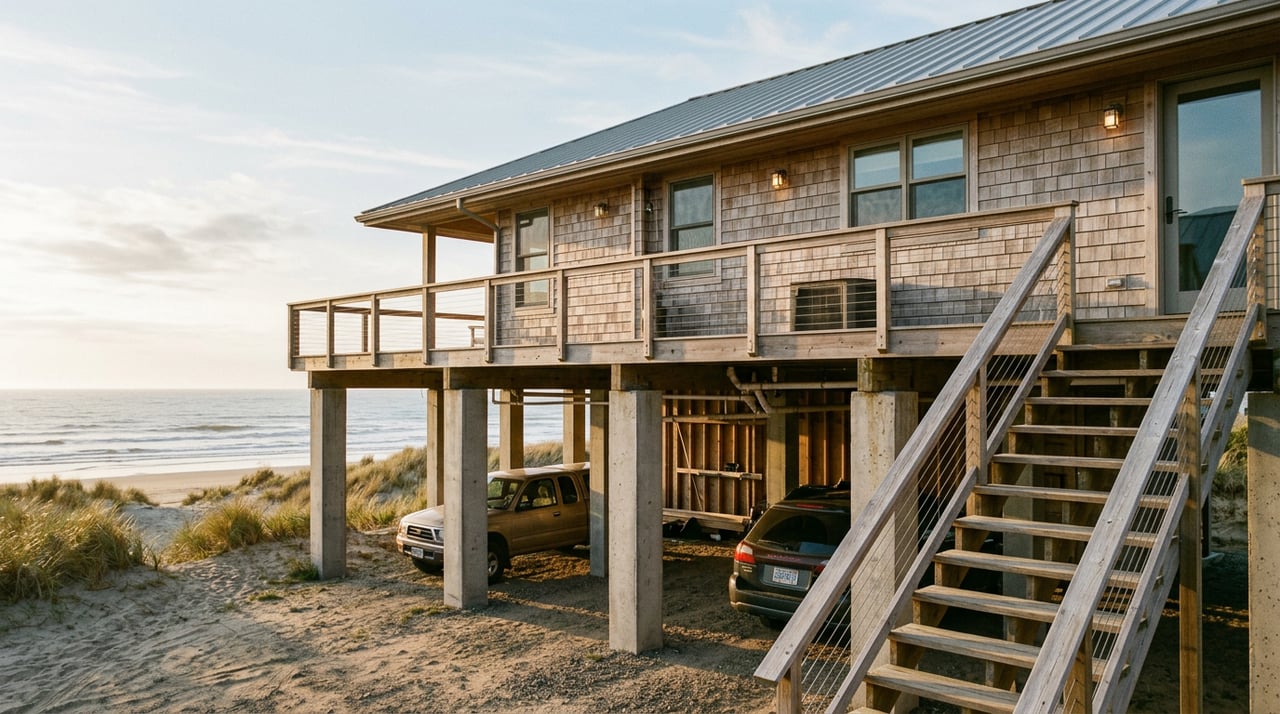
The proposal singled out this stretch of coast for a reason. TWIA data show nearly 60 percent of the state's secondary-home policies sit in just two counties, Galveston and Nueces, and Crystal Beach's home county is one of them. Jefferson County alone carries 3,974 TWIA-insured secondary-home policies with an average building limit of $191,495. Chambers County has 480 policies averaging $297,917. Combined with Galveston County, the three-county Southeast Texas region accounts for 22,632 of the 53,620 secondary-home policies TWIA insures statewide, roughly 42 percent of the entire program's second-home exposure concentrated in the counties around this office.
That concentration is the actual story. It's not that Crystal Beach got picked on. It's that Crystal Beach and its neighboring beach towns represent such a large share of TWIA's second-home book that any statewide rule change would have hit this coast harder than almost anywhere else in Texas.
The Certificate the Vote Never Touched
Here's what none of the coverage about the September 1 meeting mentioned: whether a property is a primary residence or a weekend cabin has never been the first gate TWIA checks. The first gate is a WPI-8, the windstorm inspection certificate issued by the Texas Department of Insurance confirming a structure meets the state's windstorm building code. No certificate, no TWIA policy, and most private windstorm carriers won't write the risk either.
New construction gets inspected at multiple stages, foundation, framing, roof, and final, by a TDI-licensed inspector before the certificate is issued. Existing homes built before 2003 may qualify based on their original construction date and code compliance at the time, which means an older Crystal Beach cottage can carry a valid WPI-8 without ever being reinspected. But renovations that exceed 30 percent of the home's insured value trigger a new WPI-8 requirement for the renovated portion, and that catches people who assumed a kitchen remodel or a lifted foundation repair was purely cosmetic. Getting the inspection typically runs $250 to $600 depending on the home's size and how many stages the inspector has to sign off on.
This is the document a title company and a lender actually check before closing. The owner-occupancy debate was about who gets to buy a policy. The WPI-8 is about whether the house itself qualifies at all, and that requirement isn't going anywhere no matter what the Legislature eventually does with Chapter 2210.
What the Existing Rules Already Cost
Even with the secondary-home proposal dead for now, the coverage that already exists on this coast isn't cheap, and the gap between here and an inland county is worth seeing in real numbers.
| Bolivar Peninsula (Galveston County side) | Inland Aransas County (15+ miles from coast) | |
|---|---|---|
| Dwelling value | $400,000 frame home | $400,000 frame home |
| TWIA deductible | 1% | 1% |
| TWIA wind premium | ~$7,200/year | ~$2,800/year |
| Wraparound homeowners policy | $1,800 to $2,400/year | $1,500 to $1,800/year |
| Combined annual total | roughly $9,000 to $9,600 | roughly $4,300 to $4,600 |
That's the built-in cost of proximity to the water, and it holds true regardless of whether the house is a primary residence or a second home. TWIA's standard deductible options run 1, 2, 5, or 10 percent of the dwelling's insured value, called Coverage A. The 1 percent option used to be the default everywhere, but most policies in higher-risk zip codes, Galveston Island, Bolivar Peninsula, South Padre Island, now come with a 2 or 5 percent deductible instead. On that same $400,000 dwelling, a 5 percent deductible means the owner covers the first $20,000 of any wind claim before TWIA pays a dime. TWIA's statewide average residential premium sits around $2,541 a year as of mid-2026, but that average includes plenty of inland coastal-county homes that never see the premiums Bolivar properties actually carry.
One more clause worth knowing before you're relying on it: TWIA policies exclude losses caused jointly by wind and flood, an anti-concurrent causation provision that turned into a major dispute after Hurricane Harvey and remains a live issue whenever a storm brings surge and wind damage at the same time. If an adjuster can't cleanly separate what the wind did from what the water did, the claim gets complicated fast.
The Flood Half of the Equation
Wind coverage is only half of what a Crystal Beach closing requires. Most properties on this stretch also need a separate NFIP flood policy, and the numbers there can be more surprising than the windstorm side. A home in a VE flood zone on the Bolivar Peninsula, one of the highest-risk designations FEMA uses, typically needs $250,000 in building coverage with no contents coverage and a $5,000 deductible. The NFIP annual cost for that exact coverage runs about $12,278. The same coverage on the private flood market can come in under $2,500 a year for a comparable policy, which is why more buyers are shopping private flood insurance before assuming NFIP is their only option.
NFIP building coverage also caps out at $250,000 regardless of what the home is actually worth. A buyer purchasing a $500,000 or $700,000 property above that cap needs private excess flood coverage on top of NFIP just to satisfy a lender, not as an upgrade but as a requirement.
There's a smaller, sharper wrinkle too. Parts of the Bolivar Peninsula fall inside federally designated Coastal Barrier Resources System zones. Property inside a CBRA boundary can't get FEMA flood insurance at all, full stop, and only an act of Congress can redraw those lines. It's a narrow slice of the peninsula, but if a property you're considering happens to sit inside one, no amount of shopping around gets you an NFIP policy.
Before You're Under Contract
If you're looking at a property on Crystal Beach or anywhere else on the Bolivar Peninsula, a few things are worth confirming before you sign anything:
- Ask the seller's agent whether the property has a current WPI-8 certificate on file with TDI, and if any work has been done since it was issued that might exceed the 30 percent renovation threshold.
- Get the actual TWIA deductible percentage on the existing policy, not just the premium, since a 1 percent legacy policy on an older home can be worth real money if it transfers.
- Ask your lender directly whether the home's value requires private excess flood coverage on top of NFIP, especially if the purchase price is above $250,000.
- Check whether the parcel falls inside a CBRA boundary before you assume NFIP flood insurance will be available at all.
- Build the full annual carrying cost, wind, flood, and homeowners combined, into your offer math rather than estimating off a single insurance quote.
A Couple Questions I Get Asked Often
Does this mean my current TWIA policy is safe for good? For now, yes. The proposal was pulled from this reporting cycle, and any real change would still need the Legislature to act. It's worth watching the next Biennial Report cycle rather than assuming the issue is closed permanently.
If I already have a WPI-8, do I need to worry about any of this? Not for that certificate itself, no. Where it gets relevant again is if you renovate later and cross that 30 percent threshold, which would trigger a new inspection on the affected portion of the home.
None of this is meant to scare anyone off buying on this coast. People live good lives out here, and the insurance math is knowable if you ask the right questions before you're locked into a contract instead of after. I've walked plenty of buyers through exactly this kind of paperwork on Bolivar Peninsula closings, and I'm happy to do the same for you. If you're weighing a purchase on Crystal Beach or anywhere else in Southeast Texas, Beth Westbrook would love to help you figure out what the numbers actually mean for your situation. Let's Connect.